On this page
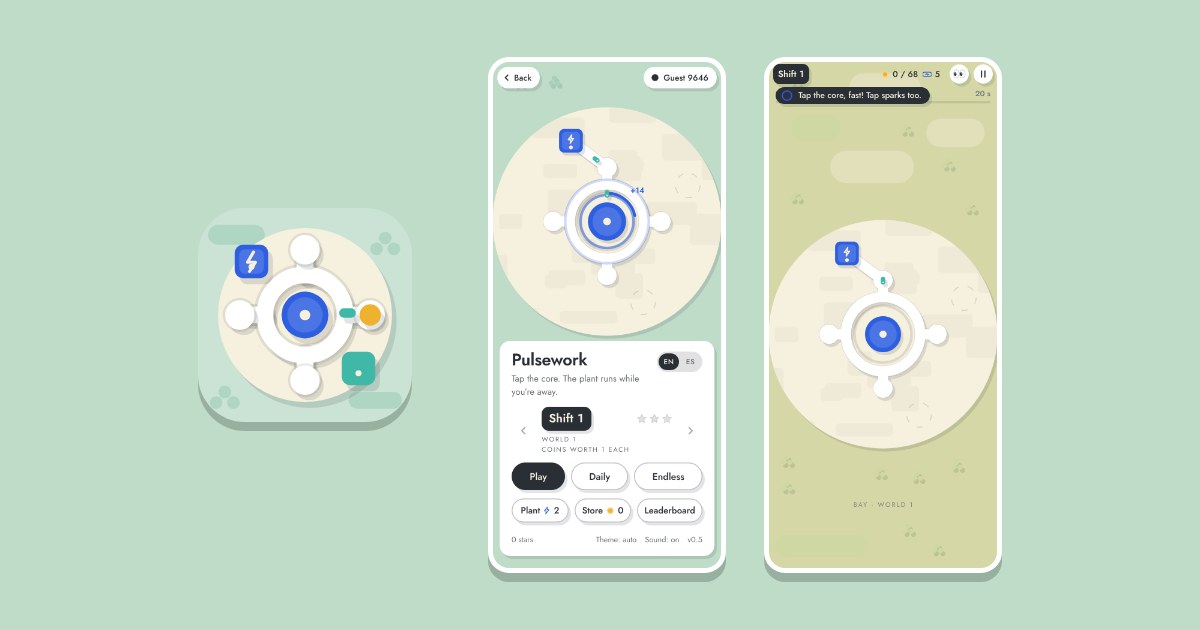
To meet a Pulsework shift, tap the core without stopping until the quota bar is full, clear every glitch the moment it shows, and take sparks when your thumb is free. A glitch costs you a fuse if you leave it, and a spark only costs you coins, so glitches come first. Between shifts, spend flux on the plant. This guide describes version 0.6, and you can play Pulsework in another tab while you read.
How does a shift work? #
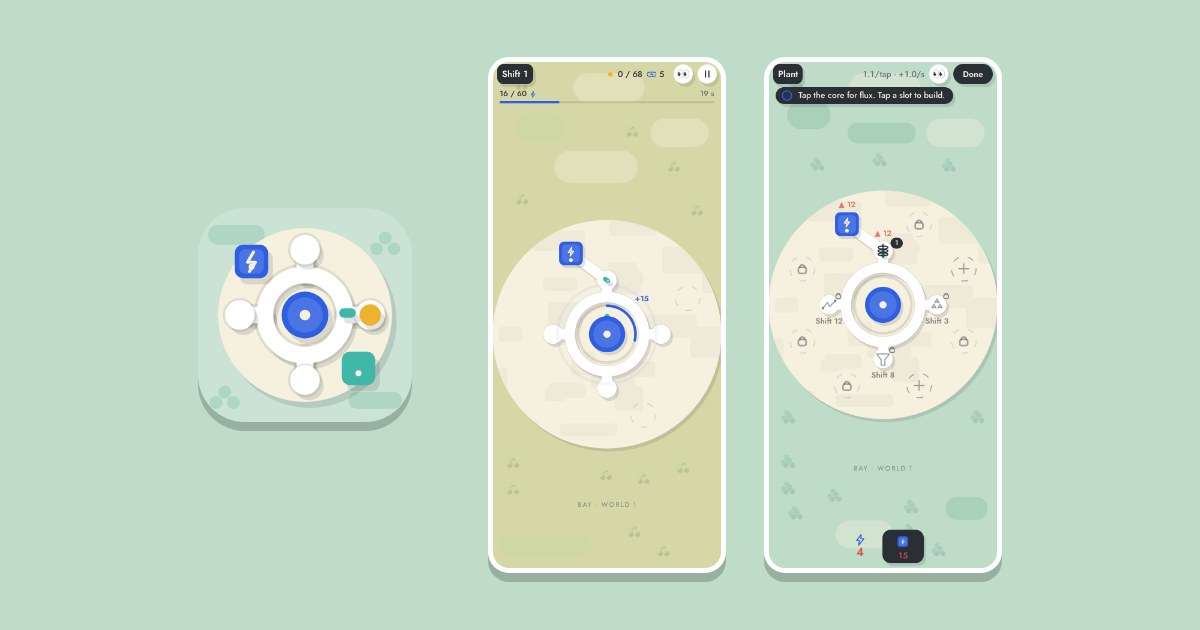
A shift is a short rush order: in its time, the core has to make a quota of flux. Shift 1 lasts 20 seconds and every later shift 30 to 40. The top of the screen shows what you need: the flux made against the quota (60 on the shift 1 below), the seconds left, how many of the shift's spark coins you have taken, and your fuses. You have five.
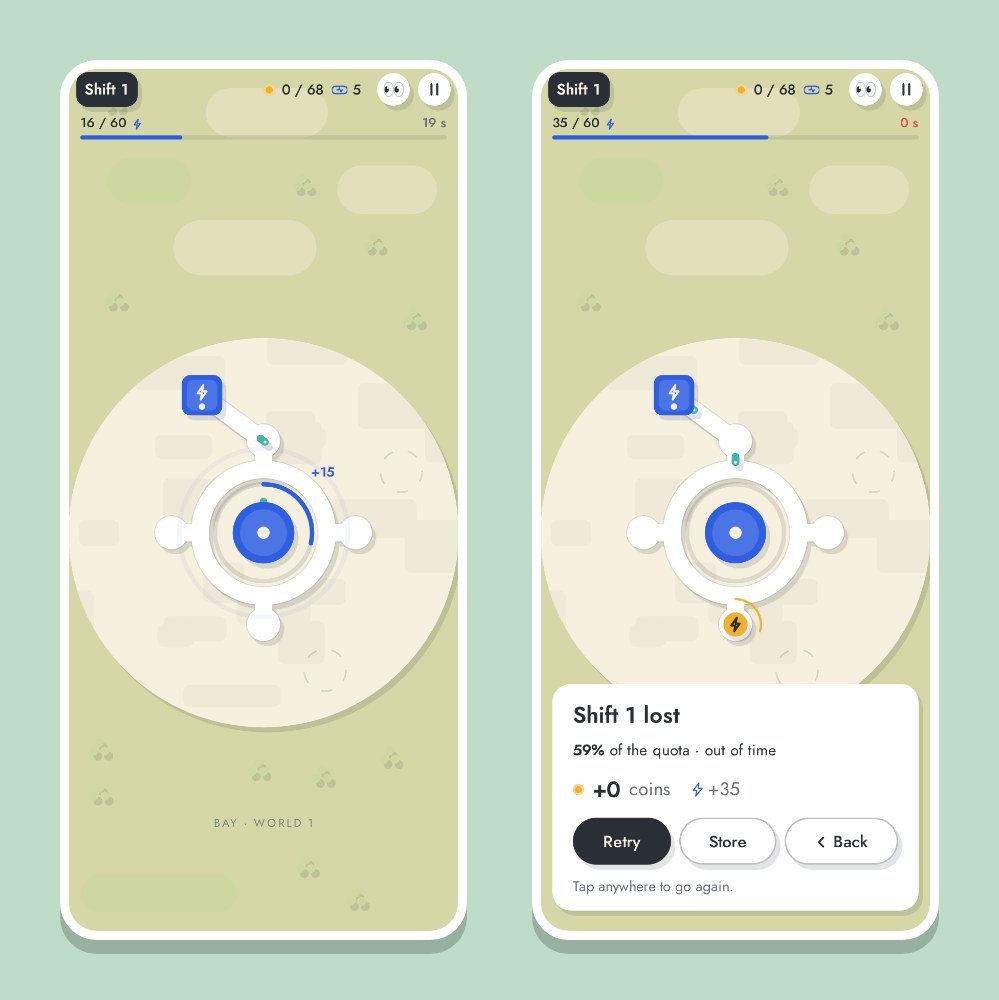
You meet the shift when the quota is made by the end. You lose it when the last fuse goes or the time runs out short of the quota. The coins you pick up from sparks are kept even when you lose, so a lost shift is not wasted.
The first five shifts ask for your own taps alone. After that a shift also expects the plant a player has by then: if yours is short, the menu says so in red. Each shift has three stars: meet it, take every spark, and meet it on the first try.
What do taps, charge and Overdrive do? #
Every tap on the core makes flux at once. In a shift a tap anywhere on the field is a tap on the core, unless a junction has something on it.
Each tap also adds 1 to the core's charge, which holds 40 and fades by 2 every second. Full, it goes into Overdrive: for 5 seconds every tap counts double. The fade is the catch. Tapping two times a second or less never fills the charge, so only a steady fast thumb gets Overdrive. The game counts at most 16 taps a second.
Two things stop the core. A tap on an empty junction is a slip and stalls it for 0.35 seconds. A dud, which comes later, stalls it for a full second and empties the charge. So tap the core freely and the junctions only when something shows on them.
Which comes first, a glitch or a spark? #
A glitch. Each glitch burning on a junction takes 25% off everything the core makes until you tap it away, and one left to burn out takes a fuse. A spark is only coins: leave it and it fades, nothing burns. The price of skipping sparks is the second star and the coins.
A glitch burns for a few seconds before it takes a fuse, and for less time on harder shifts. Shifts 1 to 3 never have more than one burning at once, 4 and 5 up to two, 6 to 39 up to three and from shift 40 up to four.
New kinds arrive with a one-line note the first time you meet them. This is where each begins:
| Kind | From shift | What it does |
|---|---|---|
| Glitch | 2 | Drains the core. One tap clears it. |
| Knot | 10 | A glitch that takes two taps. |
| Runner | 11 | A spark that jumps to the next junction every so often. |
| Hopper | 21 | A glitch that jumps to the next junction. |
| Dud | 25 | A grey spark. Tapping it stalls the core: let it fade. |
| Leech | 31 | A glitch that drains much more, 50% at first and up to 75%. |
| Flicker | 35 | A glitch that blinks out. It can only be tapped while it shows, and a tap while it is out of sight is a slip. |
| Twin | 41 | Two sparks at once, on two junctions. |
From shift 60, some plain glitches start to hop as well.
What should you buy first? #
Flux buys the plant and the tools. You make it in shifts and at the plant, and a lost shift still pays the flux it made (the one above paid 35). Coins buy the store's upgrades, abilities and shields.
A new plant has a Coil, a dynamo in one of its three slots, and 1.1 flux a tap. The other three tools open as you reach further shifts. None has a top level.
| Tool | Opens at shift | First price | What each level does | Price rises |
|---|---|---|---|---|
| Coil | 1 | 12 | Every tap makes 1.25 times as much | ×1.6 |
| Drones | 3 | 60 | One more drone, up to 8, and each one taps faster | ×1.75 |
| Conduit | 8 | 400 | A tap also takes a bigger share of what the generators make in a second | ×1.7 |
| Arc | 12 | 1,500 | One tap in 25 is critical at first, down to one in 4, and a critical tap makes 10 times as much, half a time more each level | ×1.8 |
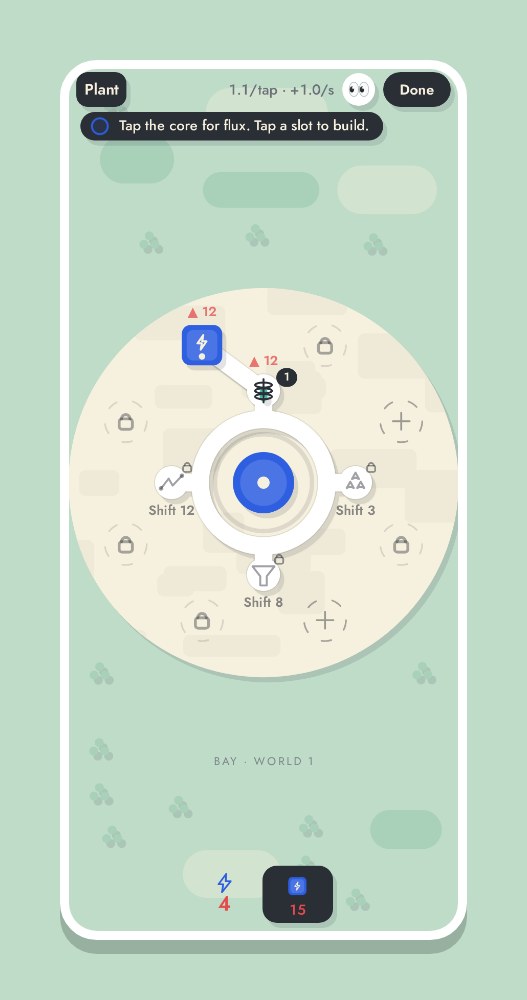
Generators make flux by themselves, which is also what pays while the game is closed (see how long the plant runs away):
| Generator | Opens at shift | Cost | Flux a second at level 1 | Output per level |
|---|---|---|---|---|
| Dynamo | 1 | 15 | 1 | ×1.3 |
| Turbine | 5 | 180 | 9 | ×1.34 |
| Reactor | 15 | 2,200 | 70 | ×1.38 |
| Lattice | 30 | 26,000 | 520 | ×1.42 |
A plant has 3 slots. Shifts 10, 25 and 50 open one each for free, and the store sells more, up to 8. Every level of a generator costs 1.75 times the one before.
The numbers suggest an order, and it is a reading of them, not something the game states. While a slot is empty, a second dynamo for 15 flux adds 1 flux a second. Raising the first dynamo to level 2 costs 12 and adds 0.3. Fill the slots first, and raise when they are full. Coil is the cheapest tool, and the first five shifts ask for your own taps alone, so it is the natural first raise. I have not tested whether Drones or Coil pays back faster after that.
Selling a generator gives back 75% of everything it cost.
Which abilities and store items help in a shift? #
Abilities are bought once with coins in the store and used from the buttons under the field, or with the keys 1 to 4 on a computer. Each has a wait before you can use it again. The prices are at coin level 1 and rise with your coin level, as in the other games.
| Ability | Opens at shift | Cost | Effect | Wait |
|---|---|---|---|---|
| Mend | 1 | 250 | One fuse back, and nothing burns for 2 s | 50 s |
| Overdrive | 4 | 400 | Overdrive at once, for 3 s | 35 s |
| Patch | 7 | 600 | Clears every glitch and holds new ones off for 1 s | 40 s |
| Surge | 12 | 900 | Taps count double for 4 s | 45 s |
Mend does nothing while all five fuses are there, and Overdrive does nothing while the core is in it already. Power and Cooldown levels bought later raise each effect and shorten each wait. Autocast, a one-time purchase, uses each ability you own the moment it would help.
Two upgrades work on the board itself: Spark magnet keeps sparks on their junctions 8% longer a level, and Insulation lets a glitch burn 10% longer before it takes a fuse. A shield, bought with coins, takes a fuse's place once.
Keep your progress #
As a guest, your progress, plant and coins stay in this browser, on this device. A free player account keeps them with your account too, so they follow you to every device where you sign in. Choose Create account the first time you open the game, or go to your account page. On a phone, add the games to your home screen to open Pulsework in one tap.